“Sae ye want tae bide a monk, aye lad!”
A Guide to Buddhist Ordination
For many people who are interested in Buddhism, the Saṅgha holds a special place of reverence as a role model. To put this in perspective, the Triple Gem can be explained as: The Buddha who prescribes the medicine for the suffering of life, the Dhamma which makes the medicine available, and the Saṅgha that helps one take that medicine in the right way in a supportive environment. The Laypeople take refuge and precepts from the Saṅgha; go for refuge to the Triple Gem, which includes the Saṅgha; treat the Saṅgha as an unsurpassed field of merit for offerings and donations; and listen to discourses, advice, and admonitions from the Saṅgha. This reverence and respect for the Saṅgha naturally lead some curious minds to speculate whether and how one can become a Saṅgha member, whether it is for them to ordain, and how one goes about it. This guide is written to answer these and related questions and to provide a structure for analyzing both the aspirant who wants to ordain and the intention to ordain.
This guide assumes the following:
1. The aspirant has already decided which school to ordain in, viz: Theravāda, Mahāyāna, or Vajrayāna; and already has been attending a monastery or temple in that school for some time to get familiar with their practices and lifestyle.
2. The aspirant has already taken the refuge and the precepts from the Monastery/Temple he has been attending.
3. The aspirant has already been studying and practicing in the lineage he has decided to ordain in. This would include studying Vinaya and Teachings as well as the Meditation they practice.
4. The aspirant may have had an opportunity to experience a Temporary Ordination where he took the 10 precepts and lived like a monk for a predetermined period of time. Such Temporary Ordinations are very common and encouraged in all Buddhist Countries. Many a time, these Temporary Ordinations run concurrently with the Buddhist Rains Retreat for 3 months, giving the aspirants a sufficiently long period of time to verify their suitability as a Buddhist monk, the ordination lineage as the one where they will be content, and for the Ordaining Authority to verify that the aspirant has genuine intentions and will be a valuable addition to their lineage.
Why ordain?
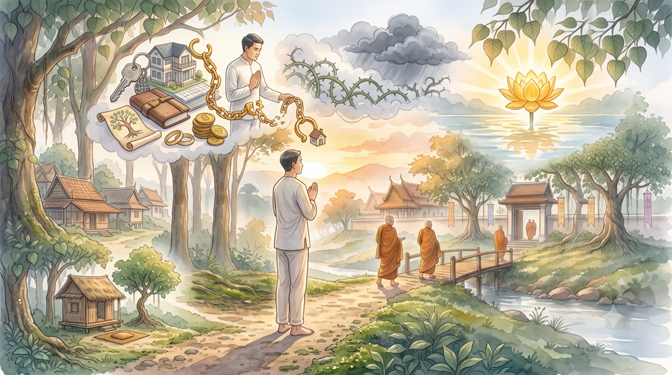
Basic motivation to ordain usually arises because of:
1. respect and admiration for the Saṅgha,
2. desire to attain nibbana,
3. desire to avoid the suffering in life,
4. not wanting to get embroiled in lay life including marriage and children, or
5. something else such as a nature from birth that inclines to seclusion and dispassion. Such a nature is usually the result of the past Pāramīs (Pāramitā)[4] and aspirations.
Who can ordain?
To ordain, one must meet the following conditions:
Age: Usually, the younger the better, especially if you are in the Western World. In the Western World, due to the need for Monks to work in the Monastery as well as to assume a larger role for the upkeep of buildings and gardens, many monasteries and Masters impose an age beyond which they will not take you in as a postulant. Usually this age is between 45 and 50 (the maximum age). The maximum age usually doesn’t apply in the Buddhist countries. Just to be clear, to have the Higher Ordination as a Bhikkhu/Bhikshu, one must be 20 years old (the minimum age).
Parental Permission: According to the Vinaya Rules, you must have permission of your parent(s) to ordain. Without this permission, you will NOT be allowed to ordain. If your parents are old, sick, financially and care-wise dependent on you, especially if you are the only child, you are encouraged by all means to take care of them and ordain only after their passing away. Keep the following 2 teachings in mind as you navigate through this guide:
Itivuttaka 106:
“Mother-father are brahmā, said to be the first teachers;
Worthy of gifts by children, compassionate for offspring”.
NDB
2.33: [5]
“Bhikkhus, there are
two persons that cannot easily be repaid. What two? One’s mother and father.
Even if one should carry about one’s mother on one shoulder and one’s father on
the other, and [while doing so] should have a life span of a hundred years,
live for a hundred years; and if one should attend to them by anointing them
with balms, by massaging, bathing, and rubbing their limbs, and they even void
their urine and excrement there, one still would not have done enough for one’s
parents, nor would one have repaid them. Even if one were to establish one’s
parents as the supreme lords and rulers over this great earth abounding in the
seven treasures, one still would not have done enough for one’s parents, nor
would one have repaid them. For what reason? Parents are of great help to
their children; they bring them up, feed them, and show them the world”.
Marital Status: Usually, Single or Divorced candidates are welcomed, but if you are still married, you may be required to have permission from your wife, preferably in writing, to free the Ordaining Authority from any legal entanglements later on.
Children: If you have children (married, divorced, out-of-wedlock, adoptees, step-children for whom you are responsible), you are usually encouraged to take care of them until the youngest child is an adult, when you are free of their upkeep – whether Moral or Legal (Child Support, Medical Support, and other Legal Obligations).
Medical Conditions: Medical conditions are generally not an issue in Buddhist countries. However, in the West, if you have a debilitating disease like back pain or inability to do strenuous work, you would be rejected outright because everyone in the monastery needs to work – I was!
Medical Insurance: While Medical Insurance is generally not an issue in Buddhist countries, in the West, these can become a huge cost and liability issue for the monasteries, and depending on their financial condition and availability of sponsors, the monasteries may decide how many monastics they can ordain and have in residence.
Visa Issues: If you choose a Western Country and are not a legal resident of that country, most likely the Monasteries and Teachers there would not ordain you due to issues related to sponsorship, visas, paperwork, and restrictions imposed by that country on religious workers. However, there are exceptions, as always: at Plum Village in France (Mahāyāna, the Thich Nhat Hanh tradition, the Vietnamese Linji Zen lineage), visa sponsorship is not a major issue. Fortunately, the French government is very accepting of foreign nationals. And the community has a good relationship with it, so as long as one’s country is not on the list of problematic countries, it’s quite easy to obtain a visa, and the visa is also usually not expensive.
Similarly, obtaining a UK visa at Amaravati (Ajahn Chah Lineage of Thai Theravāda) is not extraordinarily difficult, but it is expensive and requires an English Language Knowledge test.
A major exception here would be one in the future: if you were ordained in your country and became very famous, your Monastery Management may choose to transfer you to a third country to spread Buddhism.
Language Issues: If you choose a Teacher and/or a Monastery but that Teacher or the Monastery is not able to teach you in a language you understand, then that situation must be entirely avoided. You must NOT pursue such an opportunity until you learn that language, can interact with the Teacher and other Monastics, read their scriptures in their language, and are able to follow the instructions.
In order to learn the Teachings, it’s always best to read them in the language in which they were written and preserved. Therefore, depending on your chosen school, you should be prepared to learn the applicable language (Pāḷi for Theravāda; Buddhist Hybrid Sanskrit and Chinese for Chinese Mahāyāna; Buddhist Hybrid Sanskrit and Korean for Korean Mahāyāna; Japanese for Japanese Zen; and Buddhist Hybrid Sanskrit, Chinese, and Tibetan for Vajrayāna schools).
For example, I know of a Mahāyāna Monastery in Taiwan where several young monks from Vietnamese-American and Vietnamese-Danish backgrounds stay and learn Chinese in a reputed university for a few years and then continue their monastic journey. In fact, I was also invited, while I was there, to come learn Chinese and then teach Theravāda teachings to the Mahāyāna Monks in Chinese.
Is Ordaining the ONLY option: The final consideration would be “Can you stay as a lay person and practice? OR ordaining is the only way to reach your objective?” If you are blessed with a cooperative family and lifestyle where you can support your family while having time to engage in your spiritual pursuits, you should think twice before jumping into the fray and deciding to ordain. If you can maintain refuge and precepts and meditate regularly as a layperson, then that is beneficial to your family, friends, as well as the broader society around you. Ordination should not be an escape from the world, an escape from lawsuits or bankruptcy, an escape from your problems, an escape from the highs and lows of life. Ordaining will not solve such problems, but in fact may bring disrepute to Buddhism, the ordaining Monastery, and you, the candidate. In this context, here’s an anecdote from the famous Thai Master Ajahn Chah:
As recounted by his students, a Western monk named Aranyabho was struggling in his practice, feeling restless, unhappy with his surroundings, and constantly wanting to move to a different place to find peace. Noticing this, Ajahn Chah used a vivid analogy:
"Aranyabho's got dog shit in his pocket. He goes somewhere and sits down, but there's a bad smell, so he thinks, 'Hmm, this place is no good.' He gets up and goes somewhere else, but he notices the bad smell again, so he goes somewhere else... He doesn't realize he's carrying the dog shit around with him wherever he goes.” [6]
Beyond all of these traits, the two most important qualities are these:
MLDB 53 Sekha Sutta:
16. “He has mindfulness; he possesses the highest mindfulness and skill; he recalls and recollects what was done long ago and spoken long ago”.
MLDB 15 Anumāna Sutta:
5. (16) “Again, a bhikkhu does not adhere to his own views or hold on to them tenaciously, and he relinquishes them easily; this is a quality that makes him easy to admonish“.
When can you ordain?
To ordain, one must meet the conditions outlined in the “Who can ordain?” section. Once you meet all the conditions enumerated therein and have a Monastery willing to take you on as a candidate, you may start your monastic journey.
Where can you ordain?
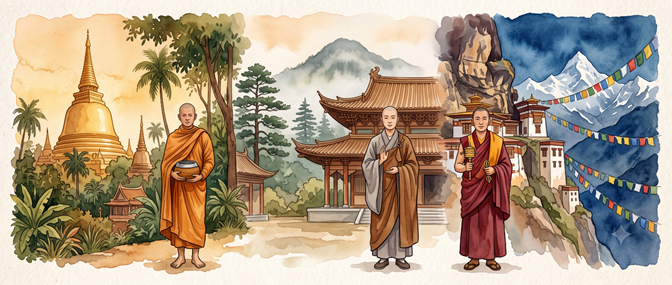
As discussed earlier, Buddhism has three main schools:
1. Theravāda: established in Sri Lanka, Myanmar, Thailand, Cambodia, Laos, and India.
2. Mahāyāna: prevalent in China, Vietnam, Taiwan, Hong Kong, Korea, and Japan.
· Japanese Zen: a special case of Mahāyāna; it’s mostly non-celibate.
· Korean Zen: It is both celibate and practice-oriented in halls called Soen Bang. The main order, Chogye, doesn’t even allow lay people or Shramaneras to enter these halls. Retreats can last 90 days. Monks sit from 8 to 20 hours a day, with no sleep permitted! It is very hard, and sometimes monks get sick or almost crazy!
3. Vajrayāna: widespread in Tibet, Northern and Eastern India (Ladakh, Dharamshala in Himachal Pradesh, Sikkim, & Namsai in Arunachal Pradesh), Bhutan, Nepal, Mongolia, and Russia.
And of course, all three schools now have temples and monasteries all over the world, so you can find them in all democratic countries, excepting most Muslim countries.
Depending on localized factors such as whether you were born in a traditional Buddhist family, the exposure to Buddhism in Childhood, the country where you were raised, the language you speak, etc., you may have experienced Buddhism in one form or another. That exposure may have made you look favorably upon the school that your parents or family follow, what is traditional in that country, etc.
Basic Structure: All three schools are organized in essentially the same way, since there is only one Vinaya. However, the interpretation and implementation of the Vinaya may differ from school to school, between the chapters within each school, and even between the sub-chapters within the same chapter.
The most common example of this is the dress code: the robes monks wear, and their color + style differ between Theravāda, Mahāyāna, and Vajrayāna schools. Then, within each school, the color as well as the measurements differ by country. Within each country, the color may differ further between each sub-chapter. Sometimes, even the day of Uposatha (when monks gather to recite the Pāṭimokkha) may differ between the sub-chapters.
Core Beliefs: Even with all the differences identified above (and there are many more left unenumerated), the core beliefs of all schools and lineages remain identical. Every Buddhist, monk or layperson, regardless of the school he is affiliated with, believes in the Four Noble Truths, Seven Enlightenment Factors, Eightfold Noble Path, 37 Aids to Enlightenment, and so on. However, depending on the school, there might be additional materials that were added later on, such as Sutra Collections (e.g., Prajñā Pāramitā Sutras, Medicine Buddha Sutra, Heart Sutra, Diamond Sutra, etc.) and Tanjur (Tengyur) in Vajrayāna, which contains later treatises and commentaries by Indian, Chinese, and Tibetan Masters.
Basic Diet: While Theravāda has no proscriptions against an Eggetarian or non-vegetarian diet, Mahāyāna has strictures against eating any meat, fish, chicken, eggs, onions, and garlic. Then again, the Vajrayāna school endorses minimizing the harm to the beings (e.g., killing one yak will feed the whole village instead of having to kill 25 chickens for the same purpose). This is driven by the fact that historically, the Vajrayāna school was resident in very inhospitable terrain and extreme weather conditions such as Tibet, Mongolia, Siberia, etc.
But the most important thing to note is that, no matter what diet you want to follow, you can. No school, except Mahāyāna, will enforce a diet on you. You need to find the right school, then the right monastery within that school which will support your diet choices. No Master in any Buddhist establishment will usually declare a food policy (except in the Mahāyāna school, where a vegetarian diet is an established doctrine and core belief), though a large number of Monasteries, even in traditionally Theravāda Buddhist countries, are now turning to a Vegetarian diet as an expression of Compassion.
Work Requirements: Most monasteries/temples in the West would require a certain amount of labor from the monastics, such as constructing buildings, stupas, pagodas, water systems, electric systems, and grounds maintenance. This is not necessarily the case in the Buddhist countries where monastics are expected to devote their time to studying the teachings, meditating, and living the monastic life.
The Teacher: Once you have a school and a monastery, the monastery Abbot or a senior monk will likely be your first choice as a teacher. OR you can do this in reverse too. First, find a Teacher by reading his books and/or listening to his sermons. Based on that, you can then approach him about how to go about being an ordinee under him.
Major Monasteries by Country & School
Here are some of the famous Monastic Ordination Institutions by country. Inquire whether they allow Temporary Ordinations so you can experience Monastic Life for a shorter period before you commit to a long term.
India:
Theravāda:
Mahabodhi Society Bangalore – Acharya Buddharakkhita lineage.
Vajrayāna:
Namgyal Monastery, Dharamshala, Himachal Pradesh – HH Dalai Lama’s personal monastery; he presides over ceremonies.
Namdroling Monastery, Bylakuppe, Karnataka – A very large Nyingma Monastic University where one can ordain and study to become a Geshe. [7]
Drepung Gomang Monastery, Drepung Loseling Monastery, and the Drepung Lachi Monastery, Mundgod, Karnataka – These are very large Monastic Universities where you can ordain and study to become a Geshe. HH Dalai Lama presides over ceremonies here.
Zen:
Bodhi Zendo, Peral Malai, Tamil Nadu – Training and Meditation institute.
Nepal:
Theravāda:
Pranidhipurna Mahavihar (Balambu Bihar) – monastic training, dharma classes, and
vipassana retreats.
Vajrayāna:
Kopan Monastery, North Kathmandu – Gelug Sub-School.
Ka-Nying Shedrub Ling, near Boudhanath Stupa, Kathmandu– Nyingma and Kagyu Sub-Schools.
Thubten Choling Monastery, Koshi Province – Nyingma Sub-School, largest active monastery in Nepal.
Thrangu Tashi Yangtse, Bagmati Province – Kagyu Sub-School.
Tengboche Monastery, Khumbu region – Nyingma Sub-School, spiritual heart of the Sherpa community.
Bangladesh:
Theravāda:
Dharmarajika Buddhist Temple (Mahavihara), Dhaka – A major center for Traditional Mass Novice Ordination.
Sri Lanka:
Theravāda:
Na Uyana Monastery, Polgahangoda near Kurunegala – Ariyananda Mahathera.
Nissarana Vanaya, Meethirigala – Dhammajīva Mahathera.
Ranagirilena Forest Monastery, Melsiripura – affiliated with Na Uyana Monastery.
Mahamevnawa Buddhist Monastery, Polgahawela – Kiribathgoda Gnanananda Thera.
There are many more suitable places. Aspirants should refer to the following sources:
(1) Buddhist Forest Monasteries & Meditation Centers in Sri Lanka
(2) Information about Meditation Centers in Sri Lanka-2013
Myanmar:
Theravāda:
Shan State Buddhist University, Taunggyi – Oxford Sayadaw.
Shwegyin Nikāya, Mandalay – Sitagu Sayadaw.
Mahagandhayon Monastery, Mandalay – Teaching Monastery.
Pa-Auk Tawya Forest Monastery, Thanlyin – Pa-Auk Sayadaw.
Mahasi Sasana Yeiktha Meditation Centre, Yangon – Mahasi Sayadaw lineage, Vipassana-oriented.
Paṇḍitārāma, Yangon – Vipassana-oriented Meditation Center.
Chan Myae Myaing Meditation Centre, Yangon – Meditation Monastery.
Thailand:
Theravāda:
Wat Pah Nanachat, Ubon Ratchathani – Ajahn Sumedho (Ajahn Chah lineage).
Wat Marp Jan, Rayong – Ajahn Anan (Ajahn Chah lineage).
Mahāyāna: Plum Village, Khao Yai – Thich Nhat Hanh lineage.
Cambodia:
Theravāda:
Wat Ounalom, Phnom Penh – Spiritual center of Cambodian Buddhism, historical seat of the Supreme Patriarch of the Maha Nikaya.
Wat Botum Vadderey, Phnom Penh – Headquarters of the Dhammayuttika Nikaya.
Wat Langka, Phnom Penh – originally established as a sanctuary for monks arriving from Sri Lanka to study the Pali Canon, a large Monastic Center.
Wat Suriya Ram, Battambang – Notable for hosting a historic 1,000 Novices Mass Ordination during Vesak Day celebrations.
Angkor-Area Monasteries, Siem Reap – They frequently host temporary ordinations, such as the Bom Bous Neak ritual, where young men ordain for the annual Rains Retreat (Vassa).
Laos:
Theravāda:
Wat Sisavangvong, Xayaboury – A national Temple (one of three), Major Monastic center.
Wat Xieng Thong, Luang Prabang – Very Historic Temple, a Pillar of Laotian Buddhism.
Wat Mai, Luang Prabang – Important Ceremonial site for Laotian Buddhism.
Wat Inpeng, Vientiane – Very old and historic site with a very ornate Sīmā. [8]
Wat Sok Pa Luang, Vientiane – Forest Monastery Center.
Malaysia:
Theravāda:
Sāsanārakkha Buddhist Sanctuary, Taiping, Perak – Founded by Venerable Aggacitta, it is a premier training center dedicated to preparing new monks and postulants to live strictly by the Dhamma-Vinaya.
Santi Forest Monastery, Ulu Tiram, Johor – Operating under the strict Thai Forest Dhammayuttika tradition, this monastery focuses intensely on silent meditation, ascetic practice, and traditional monastic training.
Mahāyāna:
Fo Guang Shan Dong Zen Temple, Jenjarom, Selangor – Serving as the national headquarters for Fo Guang Shan Malaysia, this massive 16-acre complex functions as a major cultural and monastic cultivation center. It emphasizes Humanistic Buddhism, providing extensive training programs, a tranquil Zen Garden, and structured meditation courses.
Malaysian Buddhist Institute, George Town, Penang – Established in 1969 under the Malaysian Buddhist Association, this is the only private Buddhist academy in Malaysia formally licensed by the Ministry of Education. It provides academic, Chinese-language higher education to systematically prepare candidates for full ordination into the Mahayana sangha.
China:
Mahāyāna:
Jietai Temple (Jietansi / Ordination Terrace Temple), Beijing – Supreme sanctuary for the Lu (Vinaya) sect in Northern China.
Kaiyuan Monastery, Quanzhou, Fujian Province – A major center in Fujian province.
Zhaoqing Temple/Longchang Temple, Mount Baohua, Jurong, Jiangsu Province – Major transmission center for the Nanshan lineage of the Vinaya (Precepts) school.
Hong Kong:
Mahāyāna:
Po Lin Monastery, Lantau Island – Famous monastery that has hosted early cross-regional ordinations.
PoLam Monastery, Lantau Island – Closely tied to the lineage of Master Xuyun and historical Chan/Zen training in Hong Kong.
Western Monastery, Lo Wai – Features extensive monastic housing, a Buddhist study school, a library, and facilities supporting full immersion in the monastic lifestyle.
Tsz Shan Monastery, Ting Kok – A major modern spiritual and educational center.
Asian Institute of Applied Buddhism, Lantau Island – Thich Nhat Hanh lineage.
Taiwan:
Mahāyāna:
Dhamma Drum Mountain, Taipei – A very important center for monastic training and education.
Fo Guang Shan, Kaohsiung – One of the largest in the world.
Chaoyin Chan Monastery, Guanxi – A traditional Chan monastery frequently selected by major orders (such as Chung Tai Chan Monastery) to host and transmit the full monastic precepts to novices, monks, and nuns.
Shifang Dajue Chan Monastery, Keelung City – A historic Chan (Zen) monastery with a long lineage of training and ordaining monastics.
Vietnam:
Mahāyāna:
Plum Village, France – Thich Nhat Hanh lineage.
Từ Hiếu Pagoda, Huế – Root Monastery for the Thich Nhat Hanh lineage.
Thường Chiếu Meditation Monastery, Dong Nai City – Hosts large-scale provincial and national ordination ceremonies, such as the Thien Hoa ordination programs overseen by the Vietnam Buddhist Sangha with thousands of participants.
Bát Nhã Monastery, Lam Dong – Located in the Central Highlands, historically significant for youth retreats and large joint monastic ordinations in the Plum Village tradition.
Truc Lam Meditation Monasteries, Dong Thap – A major network of Zen training and ordination centers across Vietnam (such as Truc Lam Dalat).
South Korea:
Mahāyāna:
Tongdosa Temple, Yangsan-si, Gyeongsangnam-do – The head temple of the 15th district of the Jogye Order. It is famous for housing the actual relics of the historical Buddha in its ordination platform (Geumgangjedaedan) rather than a central Buddha statue.
Haeinsa Temple, Hapcheon-gun, Gyeongsangnam-do – A core Sansa (mountain monasteries) and a primary seat of Seon (Zen) meditation and scriptural study.
Sudeoksa Temple (Yesan), Yesan-gun, Chungcheongnam-do – A major hub on Mount Deoksan where monks can immerse themselves in intensive Seon meditation and training.
Japan:
Zen: No Monastic Ordination available.
Tibet:
Vajrayāna:
Samye Monastery, Shannan, Tibet – The historic birthplace of Buddhist ordination in Tibet, where the first Tibetan monks were ordained in the 8th century under Shantarakshita and Padmasambhava. Foundational site of the Mulasarvastivada monastic lineage.
Drepung Monastery, Lhasa, Tibet – Historically the largest Tibetan monastery and a premier center for high-level scholastic training and monastic discipline.
Sera Monastery, Tibet – A great Gelug university-monastery renowned for its daily monk philosophical debates and structured monkhood education.
Ganden Monastery, Tibet – The seat of the Gelug school, integral to the lineage of the Ganden Tripa (spiritual head of the Gelug tradition).
Tashilhunpo Monastery, Shigatse, Tibet – The traditional seat of the Panchen Lama, serving as a major religious and ordination center in-tsang.
Bhutan:
Vajrayāna:
Tango Goemba, Dotanang – A premier center for higher Buddhist studies and a crucial training hub for religious leaders and scholars in the Drukpa Kagyu tradition.
Cheri Monastery/Chagri Dorjeden, Thimphu – Bhutan's first major monastery, founded in 1620, serving as an important silent retreat and teaching center.
Lhodrak Kharchu Monastery, Jakar – Founded in the 1980s, it functions as a prominent institution teaching Buddhist philosophy, logic, and meditation to hundreds of monks.
Tashichhoe Dzong, Thimphu & Punakha Dzong, Punakha – Dual-purpose administrative fortresses (dzongs) that house large central monk bodies (dratshang) and act as official seats for seasonal monastic administration and state rituals.
Ramthangkha Monastery, Paro region – Noted for hosting milestone full-ordination ceremonies for the country's monastic nuns.
Mongolia:
Vajrayāna:
Gandantegchinlen Monastery, Ulaanbaatar – Serves as the primary headquarters of Mongolian Buddhism and the country's main spiritual center. Acts as the main venue for novice and monk ordinations, including historic mass ordinations. Houses the Zanabazar Buddhist University (and associated Buddhist colleges) where monks undergo formal training and ordination paths.
Dashchoilin Monastery, Ulaanbaatar – An active and revived monastic center involved in restoring traditional Tibetan-Mongolian Buddhist practices and lineages.
Erdene Zuu Monastery, Kharkhorin – The oldest surviving monastery in Mongolia (founded in 1585/1586), which resumed its active role as a temple and monastic community following the 1990 democratic transition, though major large-scale institutional training and ordination are primarily centralized in the capital.
FPMT Mongolia-Center of the Great Vehicle, Ulaanbaatar – Supports local practitioners, including the growing community of first-generation ordained nuns and monks reviving Vinaya and study programs in the post-communist era.
Russia:
Buddhist ordination and monastic training in Russia primarily take place within the Tibetan Gelugpa tradition, centered in regions such as Buryatia, Tuva, and Kalmykia.
Vajrayāna:
Ivolginsky Datsan, Buryatia – Located near Ulan-Ude, this is the historic and administrative center of Buddhism in Russia. It houses the Dashi Choynhorlin Buddhist University, where monks receive traditional monastic education, scriptural training, and foundational ordination.
Aginsky Datsan & Aginsky Buddhist Academy, Transbaikal Territory-Zabaykalye – Founded in the early 19th century, this complex features a spiritual and professional educational institution that trains lamas and supports monastic scholarship in the Gelug tradition.
Thubten Shedrub Ling, Tuva – Located in Kyzyl, this is Russia's largest Buddhist monastery complex. Its abbot and monastics often complete advanced training abroad at traditional seats of learning, such as Drepung Gomang Monastery in India, and return to guide local practice and ceremonies.
Burkhan Bakshin Altan Sume, Kalmykia – Located in Elista, this major Gelugpa temple serves as the spiritual hub for Kalmykia, the westernmost region of traditional European Buddhism.
Ordination Process
The Ordination Process differs from School to School, country to country, and even chapter to chapter. Let’s review a few ordination process flows:
Theravāda: The usual stages are (1) Anagarika or Postulant, (2) Sāmaṇera (trainee ordination), and (3) Bhikkhu (the higher ordination). However, this is then further moderated by (A) the origin country, and (B) whether the monastery is in a Buddhist or a non-Buddhist country.
India: Usually, no stages are skipped. Postulants are brought in at a younger age to identify their suitability for a lifelong monk status, and they are extensively trained.
Myanmar and Thailand: Usually, the Anagarika and Sāmaṇera stages are skipped (or included as part of higher ordination on the same day, provided you are 20 years or older), and you are directly ordained as a Bhikkhu.
Sri Lanka: Usually, the lay people would first start as an Anagarika, stay for a few months and show their suitability to be a Buddhist monk, and then they can proceed further. The qualities the Teacher is looking for are humility, how easy it is to admonish the candidate, how easily he mixes in with the existing Saṅgha, etc. The Sāmaṇera stage is usually never skipped, and you have to be a Sāmaṇera until your Teacher allows you to take ordination as a Bhikkhu. Under Sri Lankan law, both Sāmaṇera and Bhikkhus have to register with the Ministry of BuddhaSāsana in Sri Lanka. The Registration allows Sri Lankan Nationals to get the monastic ID.
Western Countries: In Western countries, the process is more rigid with fewer exceptions since they want to ensure that only dedicated persons join the Saṅgha. Many Western country Saṅghas do the Anagarika and Sāmaṇera ordinations locally, sending ready candidates to the home country for ordination and a period of stay in the home country to see and learn about Buddhism from the locals.
Mahāyāna: The usual stages are (1) Shramanera (trainee ordination), (2) Bhikshu (the higher ordination), and (3) Bodhisattva ordination. However, this is then further moderated by (A) the origin country, and (B) whether the monastery is in a Buddhist or a non-Buddhist country.
China: The exact requirements of how long you have to stay as an Anagarika and Shramanera are unknown, and so are the lineages and teachers. Given that China is a controlled state, there might be requirements such as vetting and approval by the state.
· Candidates must spend at least one to two years living as an unordained layperson or informal trainee (xiangfa shami) at a home monastery, practicing community life and proving their character.
· Modern applicants must present an official recommendation letter from their master, pass written and oral exams on Buddhist liturgy, and provide a clear health examination certificate.
· Candidates face strict questioning about classical disqualifiers. They must be human, free from major debilitating physical illnesses, free of debt, have parental and/or spousal permission, and be at least 20 years old.
· Once accepted into the intense multi-week camp, candidates undergo three distinct tiers of transmission (the Triple Ordination). During this time, they wake up as early as 4:00 AM, undergo grueling physical endurance training, and master complex prostration rituals.
· Triple Ordination 1: Novice Ordination (Shami Jie 沙彌戒)
· Candidates formally take the 10 Novice Precepts, marking their official entry into the Sangha.
· They receive their formal monastic robes and alms bowls. They pledge to live a life of poverty, celibacy, and intense discipline.
· Triple Ordination 2: Full Ordination (Bhikshu Jie 比丘/比丘尼戒)
· This is the highest level of monastic ordination. Monks (Bhikshus) take 250 precepts.
· The ceremony must be witnessed and transmitted by a highly selective legal panel of "Three Preceptors and Seven Witnesses" (San Shi Qi Zheng), who are all respected senior monastics.
· Triple Ordination 3: Bodhisattva Precepts (Pusa Jie 菩薩戒)
· While the first two ordinations focus on individual liberation (Theravada), the third ordination infuses the ceremony with Mahayana Mahasattva ideology. Candidates take the 58 Bodhisattva precepts from the Brahma Net Sutra, vowing to remain in the cycle of rebirth until they save all living beings.
· The Scarring Ceremony (Shaobing 燒頂): A defining characteristic of Chinese Mahayana tradition occurs during this final stage. Small cones of incense are placed on the shaved scalp of the monastics and lit, leaving permanent circular scars (jieba 戒疤). This painful process is a physical manifestation of their vow to burn away defilements and to sacrifice their bodies for the Dharma. In modern times, this is largely optional or symbolic due to health regulations, but it remains heavily practiced in conservative lineages.
· Upon the successful completion of the triple ordination, the monastics are issued an official Ordination Certificate (Jiedie 戒牒) by the national Buddhist authority. They participate in a ceremonial alms round (tuobo) to receive offerings from local lay devotees, cementing their transition from trainees into full, independent fields of merit for society.
Taiwan: Usually, the ceremonies last 30 days, including the Shramanera, Bhikshu, and Bodhisattva stages, each a separate ceremony. There are many well-known lineages in Taiwan such as Dhamma Drum north of Taipei and Fo Guang Shan in Kaohsiung.
Vietnam:
· Anagarika: In the Thich Nhat Hanh (the Vietnamese Linji Zen lineage), one has to become Anagarika for about a year. Then the candidate makes a request to the community for Going Forth (Pabbajja, to become a Shramanera). If the community sees that they aren't ready or not suited to monastic life, it's possible that the request is rejected.
· Shramanera: To become a Shramanera, one has to be above 18 at the monasteries in the West, or at any age in Asia (there is a big monastery in Thailand). And the maximum age is 50. So if one is over 50, there is basically no chance for ordination unless the community makes an exception. Normally, Shramanera state lasts for 3 years, then there will be Bhikshu Ordination so long as the candidate is over 20 years. However, Bhikshu Ordination is organized only once every 2 years, so alternately there will be a group that spends 4 years as Shramanera.
· The Bhikshu Ordination ceremony is very big and complex. The highest venerables from Vietnam are invited, and there will be more than a week of preparation, including paying respects to the venerables, making the formal request for higher ordination, familiarizing themselves with the ceremony procedure, and so on. The entire fully ordained community has to be present for the ceremony.
· Concerning Bodhisattva vows, it's a little confusing, but it's like taking 5 or 8 precepts. One can make a vow and receive the precepts as a monastic or a lay. So it's NOT an ordination.
Japan:
· There is no Shramanera or Bhikshu ordination in Japan. Taking Bodhisattva vows is used for Preacher ordination.
· Only in Japan do all Buddhist sects use it as monastic (or, more precisely, Preacher) ordination, and there are no actual monastic precepts for them to receive. This new trait was put forth by Japanese Tientai monk Saicho 最澄. He basically changed the entire trajectory of Japanese Buddhism.
Korea:
· Most lineages in Korea are both Mahāyāna and Zen, even though some are more inclined to the Pure Land School.
· In the Chogye lineage, the largest celibate order in Korea, one starts as a haeng-ja (similar to the Anagarika training; they wear dark brown robes and mostly work in the kitchen for about six months).
· Then one becomes a Shramanera for 4 full years. Usually they are over 20, perhaps because of reduced interest in ordaining. During that time, most attend so-called “sutra-school” where they don't learn sutras so much, but chanting, rules, etc. After that, it is possible to ordain as a Bhikshu.
· For Bhikshu ordination, which lasts for 3-4 days, first Bodhisattva precepts are given and then 250 Mahāyāna precepts. This Ordination ceremony takes place once a year.
Western Countries: In Western countries, the process is more rigid with fewer exceptions since they want to ensure that only dedicated persons join the Saṅgha. For example, in the “City of Ten Thousand Buddhas” Monastery in Ukiah, California, USA, which is in the Dharmagupta lineage in the Guiyang (or "Weiyang") Chan lineage transmitted to the Ven Hsuan Hua from Xuyun ("Empty Clouds"), the specifics are as follows:
· Anagarika: At the Ukiah monastery, it's been variable as to how many years of lay service before Shramanera vows can be taken. Usually it is 2 years.
· Master Hua used to allow Shramanera ordination for mid to late teen years. The current situation may be different.
· One can become Bhikshu at the minimum age of 20 years. However, there is no maximum age after which they will not ordain you, if you meet other criteria.
· Usually the ceremonies last 108 days, including Shramanera, Bhikshu, and Bodhisattva stages; each being a very separate ceremony. Thus, it's quite usual for candidates for full ordination to be formally ordained Shramanera for many years. During those sessions, the bhikshu vows are taken toward the end, and usually about a week later, the bodhisattva vows are transmitted. It’s unheard of anyone taking only the bhikshu, and not the bodhisattva vows soon afterward, but they are definitely separate sub-ceremonies transmitting separate precept lineages in the overall context of the ordination session - thus the vows and their transmission are not admixed in any way. As far as the content of the lists of vows in both Dharmagupta and Bodhisattva-precept lineages, they are all the same, i.e., no differences in the wording or number of the vows. There are different Vinaya teaching lineages, but they all use the same lists of Dharmagupta and bodhisattva precept vows, the latter as contained in the Brahma's Net Sutra.[9]
Vajrayāna: The usual stages are (1) Shramanera (trainee ordination), (2) Bhikshu (the higher ordination), and (3) Bodhisattva ordination. However, this is then further moderated by (A) the origin country, and (B) whether the monastery is in a Buddhist or a non-Buddhist country.
Tibet: Usually there is no Anagarika stage, but this could differ by the sub-school and tradition. The levels of vows are as follows:
· Rabjung/Getsul: Novice ordination vows (shramenera)
· Gelong: Full ordination (bhikshu)
Bhutan: Same as Tibet.
India: The Shramanera stage is usually never skipped, and you have to be a Shramanera until your Teacher allows you to take ordination as Bhikshu. There are many Vajrayana Training Monasteries all over India, and one can easily approach them.
Mongolia: Same as Tibet.
Russia: Same as Tibet.
Western Countries: In Western countries, the process is more rigid with fewer exceptions since they want to ensure that only dedicated persons join the Saṅgha.
Ordination Stages
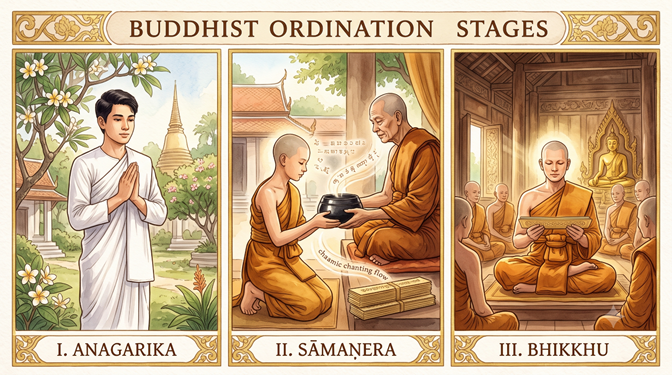
Anagarika/Postulant: This is NOT a recognized step in the Ordination Process. It has no formal Vinaya process or recognition. As such, it is NOT part of the Monastic Saṅgha. Nonetheless, it is still very much a part of the Lay Saṅgha. A few famous examples of this would be the pioneering Sri Lankan Buddhist Activist Anagarika Dharmapāla (later ordained as Venerable Sri Devamitta Dharmapāla) and celebrated Anagarika Munindra (who was a Bhikkhu for 10 years or so and decided that Dhamma Transmission to Lay People would work better as an Anagarika). The Monastery or Lineage where you first become an Anagarika may recognize it in some way, such as calling you a Candidate, a Postulant, or an Anagarika. As part of this, the Monastery or Teacher may give you the refuges and eight precepts. The period may last 6 months to 2 years and more, depending on the school, country, lineage, and what the Teacher thinks about the required time period.
Sāmaṇera/Shramanera: This is the first recognized step on the Ordination journey in the Vinaya. Once you successfully demonstrate your suitability as an Anagarika, the Teacher and the Monastery may take you to the next step. The steps to become a Sāmaṇera/Shramanera are usually pretty straightforward and do NOT require a larger presence or quorum of the Saṅgha. The process to make you a Sāmaṇera can be done singly by the Teacher with or without quorum, usually in the presence of Lay People. First, if you are still not clean-shaven, the process to remove the head-hair will be conducted. Second, you will request and be offered the Monk Robes along with the other requisites (Aṭṭha-Parikkhāra or the Eight Requisites)[10]. Then, the Other Monks will help you get dressed in the Robes (believe me, this is a very important step!). Third, you will return to the Assembly dressed in the Monk Robes, where you will be given the Triple Refuge and the 10 Precepts. At this point, you become a Trainee (Sāmaṇera/Shramanera) and can rightly be addressed as a Venerable! In many Buddhist countries, this process is registered and documented with the Ministry of Buddhism (e.g., with the Ministry of BuddhaSāsana in Sri Lanka). The outcome is a registration certificate as a Sāmaṇera/Shramanera. In most Western countries, there is no such registration. In those countries, the Monastery or Lineage would normally either (1) send you to get ordained in the source Buddhist country, or (2) ordain you in the host country and then send you to the source Buddhist country for Bhikkhu Ordination. After you become a Sāmaṇera/Shramanera, your teacher, appointed at the ordination time (called Upajjhaya), will take you under his wings and show you the ropes, teach you the basics of monk life, etc. A larger monastery with a high volume of Sāmaṇera/Shramanera might run regular Vinaya Study classes, Sutta Study classes, Meditation Classes, and a Cultivation class to teach the Aspirants how to walk and move, wear robes, go for Almsround to the local area and villages, etc. Most of these Rules of Decency and Deportment are codified in the Sekhiya – the 75 training rules which are part of the Pāṭimokkha.[11] In some monasteries, this training process will necessarily differ for locals vs. foreigners. Locals will be trained much more vigorously in the local traditions to serve the local Buddhist community (such as Protection Chants, visiting locals at their home, visiting Buddhist Funerals, etc.), while Foreigners may be trained vigorously in Vinaya and Sutta so they can take it back to their Home Countries to plant a new monastery.
The Sāmaṇera/Shramanera stage may last anywhere from 6 months to 2 years and is entirely at the discretion of the Teacher.
Bhikkhu/Bhikshu: When your teacher believes you are ready to be ordained as a higher-ordained monk, or Bhikkhu/Bhikshu, he will put in motion the steps that lead you there. How do teachers find out that you are ready? This is a judgment call, but it’s based on long experience. Basically, teachers are looking for pupils who are humble, easy to admonish, and not troublemakers. They are also noticing your contentment with having nothing, your confidence in the Triple Gem, how you deal with Sangha members as well as lay people, how well you teach others, and your erudition.
The Teacher and the Upajjhaya will teach you about the Bhikkhu/Bhikshu Ordination process and ceremony, the basics of how to answer questions put to you at the higher ordination ceremony, what you must bring to get ordained (the eight requisites), how you must enter the ordination hall and behave, how you must answer the questions put to you, et. al. etiquette.
Every school of Buddhism and every lineage has Vinaya experts who act as chaperones to the aspiring candidates and make sure every i is dotted and every t is crossed. At the end of the ordination process, a formal Ordination Certificate is issued. In Buddhist Countries, this certificate is registered with the Local Ministry of Buddhism (e.g., with the Ministry of BuddhaSāsana in Sri Lanka).
In some cases, the Ordination Organization may ask the ordinee to contribute to the maintenance and upkeep of the Ordination Hall (Sīmā) and the Registration Organization. Even if asked unprompted, be generous and donate to ensure the welfare of future candidates. Those with strict money handling rules can appoint a Kappiya or donate while they are Anagarika (between noon disrobing and the afternoon Higher Ordination - this is done so that the candidates can hug and say goodbye to their parents and siblings as lay people).
In different traditions, the length of the Higher Ordination ceremony is different. In Theravāda, it’s done in a few hours – morning session for the Q&A to test the candidate’s recall of requisite knowledge and the afternoon session to administer formal ordination. In Mahāyāna, it could take between 30 and 108 days and include taking Bhikshu vows, followed by the Bodhisattva vows. In Zen, it lasts 7 days, so each School and lineage has its own standards and precedents to follow.
Who Will Take Care of Me?
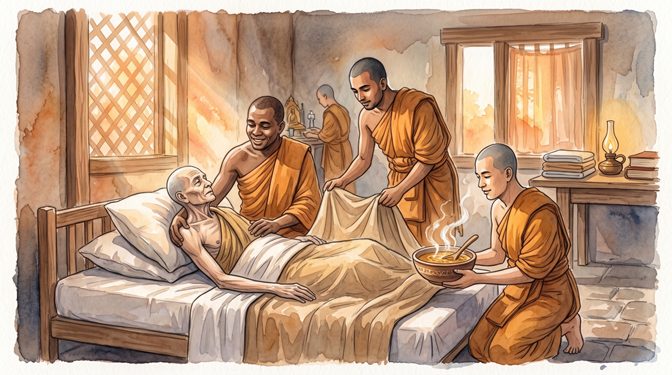
Aye, now we come to an important consideration. Once a candidate renounces the World, his previous relations are placed in abeyance, are suspended. Now, the Saṅgha assumes the role of Father-Mother-Brother-Sister of the Candidate. Remember the word Sāmaṇera/Shramanera we have been using? Here’s the origin of that word:
“Samaṇassa putto ti Sāmaṇero” = ”Sāmaṇero means the son of Samaṇa” = “The Son of Renunciate”.
Thus, the system that takes you on as its own son - how can that system let you down when you need it the most? Both the Candidate and the Saṅgha have duties towards each other, and that includes taking care of each other, come hell or high water. And you are expected to live by the same standard with respect to your co-farers in the Holy Life. Here’s an abridged and paraphrased story of how Lord Buddha established the Gold standard.
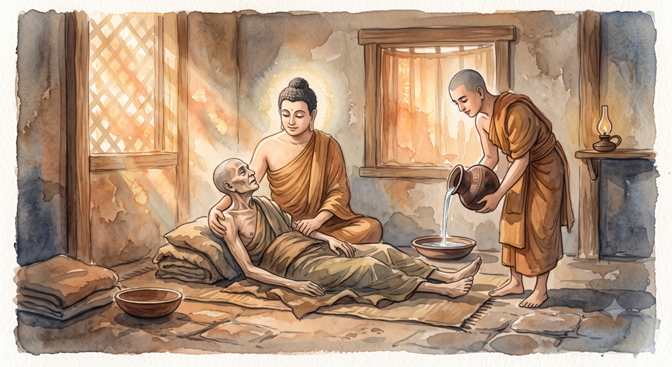
Once upon a time, during an Inspection Tour of the Saṅgha Quarters, accompanied by his attendant, Venerable Ananda, Lord Buddha heard a monk groaning and crying in pain. The monk was lying in his own filth due to an acute disease and had no attendant to help him. Lord Buddha lifted him while Venerable Ananda washed him with fresh water, and then they placed the sick monk on a clean bed.
Then, in the evening, Lord Buddha had the Saṅgha assembled. Upon inquiry into why the sick monk wasn’t being cared for, other monks admitted he was of no help to them. Then Lord Buddha rebuked the monks and told them:
"Monks, you have no mother, you have no father, who might tend to you. If you don't tend to one another, who then will tend to you? Whoever would tend to me, should tend to the sick.” [12]
Is Ordination the final WORD?
The simple answer is: No, Ordination is reversible at every step, and one can return to a Lay State, if and when the need arises. The key thing to remember is this: if you have gone forth and ordained with a genuine desire, and not just to escape the world; then your desire to return to the world should also be based on a genuine need.
The Numerical Discourses of the Buddha (Aṅguttara Nikāya) 6.60 refers to Venerable Citta Hatthisāriputta as falling back to the lay state, and then re-ordaining and becoming an Arahant. The Kuddāla Jātaka (#70) refers to the same Venerable as having fallen to the lay state 6 times, resulting in a total of seven ordinations and the final one being successful, leading to Arahantship.
If your mother or father are old or sick and have no one else to take care of them, then you are of course free to return to lay life to take care of them. Or even as a Higher Ordained Monk, you can move closer to them and help them in any way you can. As mentioned in the “Who Can Ordain? > Parental Permission” section, you would earn far more merits taking care of your parents since their debt is impossible to pay off. In fact, their debt is so hard to pay off that monastics are allowed to share their gains with their parents.
There is an excellent example of this in the Majjhima Nikāya. In the MLDB 81 Ghaṭīkāra Sutta, Ghaṭīkāra is a supporter of the Buddha Kassapa but doesn’t ordain because he has to take care of his blind and aged parents. He is a close friend (BFF) of our Lord Buddha, born in that life as Jotipāla. Ghaṭīkāra is already a Non-Returner (the Third Stage of the four-stage enlightenment). Upon death, he passes away to the World of Non-Returners, where he attains Arahantship (the Fourth and final stage of arahantship). He returns and reports to our Lord Buddha about seven disciples born in the Non-Returners world (Connected Discourses of the Buddha-Saṃyutta Nikāya 1.50 Ghaṭīkāra Sutta).